
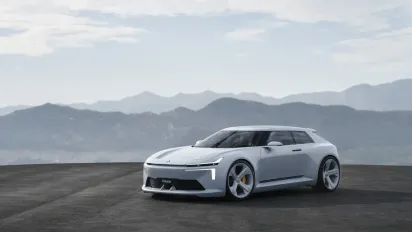
Polestar has never been particularly interested in making ordinary-looking cars, and its latest creation certainly continues that tradition. The Swedish electric performance brand has revealed the Formula 2030, a low, wide four-door sports car that previews the design direction of its future models, including the next-generation Polestar 2 and upcoming Polestar 7.
Unveiled on 10 November 2026, the concept is the first show car developed under Polestar's Head of Design, Philipp Römers. Although the Formula 2030 isn't intended to go into production in its current form, Polestar has confirmed that several of its design features will make their way onto future road cars.
For anyone considering a Polestar in the coming years, that makes this considerably more interesting than the average motor show concept.
A Dramatic New Look for Polestar
The Formula 2030 has the proportions of a sports car, although its unusual body shape makes it difficult to place into a conventional category. There's something of a shooting brake about its long roofline, while the muscular wheel arches and short overhangs give it a particularly purposeful appearance.
Measuring 4,680mm long and 2,021mm wide, with a height of just 1,350mm, it's lower than the Polestar 5 Grand Tourer. Despite those sleek proportions, it still accommodates four individual seats and four doors.
The exterior features enormous 22-inch alloy wheels, an elongated bonnet and Polestar's distinctive Dual Blade headlights. At the front, the lighting has been incorporated into a new aerodynamic design, complete with a pronounced splitter and a sculpted nose.
Perhaps the most important detail is that Polestar has confirmed this front-end design previews the next-generation Polestar 2, which is expected to arrive in 2027.
At the rear, the familiar full-width light bar has been replaced by a new Single Blade lighting arrangement. This is another feature expected to influence future production models, including the Polestar 7.
Other interesting touches include a single vertical windscreen wiper, wraparound glazing and a concealed LiDAR sensor that emerges when the concept's autonomous driving functions are activated.
It looks thoroughly futuristic, although the overall design is still recognisably Polestar.
Inside, Physical Buttons Are Making a Comeback
One of the most interesting developments is inside the Formula 2030, where Polestar appears to be reconsidering the increasingly touchscreen-dominated interiors of modern cars.
The dashboard features a curved 20-inch driver information display, known as HyperDIM, alongside a 12.2-inch central touchscreen.
However, beneath that central display sits something many drivers have been asking manufacturers to bring back: proper physical controls.
Polestar has incorporated eight customisable switches and buttons, allowing drivers to select different types of controls and assign them to frequently used functions.
It's a welcome idea, particularly as many everyday functions in modern electric cars require navigating several touchscreen menus.
The concept also introduces three driving modes: Performance, Normal and Autonomous.
Selecting a mode physically changes the interior arrangement. In Performance mode, the steering wheel and driver display move closer to the driver, while the central screen lowers into the dashboard. Autonomous mode moves the steering wheel and seat further apart, creating a more relaxed environment.
Four individual seats feature inflatable bolsters that adjust to support their occupants, while the cabin uses a mixture of traditional materials and more experimental components.
Google Gemini is also integrated into the concept's infotainment system, allowing occupants to interact with the vehicle through conversational voice commands.
Exactly how much of this technology will reach production cars remains to be seen, although Polestar has made it clear that the balance between physical and digital controls is an important part of its future interior design.
Sustainability Is Still a Priority
Alongside design and performance, Polestar continues to explore ways of reducing the environmental impact of vehicle manufacturing.
The Formula 2030 features a new exterior colour called Nitrogen, applied across much of the bodywork and even the alloy wheels. Different surface finishes provide contrast, while Swedish Gold detailing appears on the brake calipers, seatbelts and other components.
Inside, the concept uses low-emission galvanised steel for structural components, while the seat backs incorporate a composite made with European flax and bio-based polypropylene.
Polestar has also developed door materials designed to be easier to recycle, using components from the same polymer family.
These are experimental applications, but they provide an insight into the materials and manufacturing approaches Polestar is investigating for future vehicles.
What Does Formula 2030 Tell Us About the Next Polestar 2 and Polestar 7?
Although the Formula 2030 is a design study, its significance lies in the production models that will follow.
The next-generation Polestar 2 is planned for 2027 and is expected to introduce an updated interpretation of the brand's familiar design. Polestar has already confirmed that the Formula 2030's distinctive front-end treatment provides a preview of that vehicle.
The Polestar 7, a compact premium electric SUV planned for 2028, will also incorporate design features introduced by the concept.
Both vehicles form part of Polestar's wider expansion plans, which include a growing range of electric cars across different segments.
There are currently no confirmed battery capacities, driving range figures, performance specifications or prices for the Formula 2030. As a concept vehicle, it shouldn't be viewed as an indication of what customers will be able to order directly.
Nevertheless, the design demonstrates where Polestar wants to take its brand over the next few years.
What Does This Mean for Polestar Customers?
For existing Polestar owners and those considering switching to an electric vehicle, the Formula 2030 offers an encouraging glimpse of the brand's future.
The emphasis on driver engagement and easier access to everyday controls could be particularly welcome. Meanwhile, the next Polestar 2 and Polestar 7 should help broaden the manufacturer's appeal to customers looking for premium electric vehicles.
In the meantime, the current Polestar range already offers a choice of models, from the established Polestar 2 to the larger Polestar 3 and Polestar 4.
At Rivervale, we help customers explore electric car leasing options across a wide range of manufacturers, making it easier to compare vehicles, specifications and monthly costs.
While the Formula 2030 itself isn't available to lease, its influence could soon be seen on the next generation of Polestar vehicles arriving on UK roads.
Explore our latest Polestar leasing deals at Rivervale and discover the electric vehicles available today.
Current Polestar Personal & Business Contract Hire Leasing Deals


