
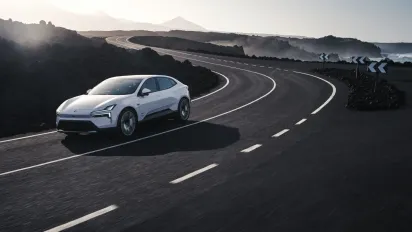
There is no shortage of premium electric SUVs, but the Polestar 4 manages to feel different from many of them.
Some of that comes from its striking SUV-coupé design and unusual decision to dispense with a conventional rear window, but the more important differences become apparent from behind the wheel.
This feels like a car developed by a manufacturer that still cares about steering, chassis behaviour, seating position and how confident a car feels when the road begins to twist.
Following an opportunity to drive the complete Polestar range at Bicester Motion, we subsequently spent several days with the rear-wheel-drive Polestar 4, including a journey of around 200 miles and driving through a mixture of motorways, towns and the B-roads of the South Downs.
It proved to be an impressive everyday EV.
What versions of the Polestar 4 are available?
The current Polestar 4 Coupé range is relatively straightforward.
The Rear motor model starts from £56,750 and sends 268bhp to the rear wheels. It offers up to 385 miles of WLTP range and takes around 7.1 seconds to reach 62mph.
Move to the £63,750 Dual motor and output doubles to 536bhp, with all-wheel drive and 506lb ft of torque. The 0-62mph time falls to approximately 3.8 seconds, while official range stands at up to 367 miles.
Both use a 100kWh lithium-ion battery.
The Rear motor is likely to make the most sense for a large proportion of drivers. Its performance is brisk rather than dramatic, but it never feels underpowered in normal driving and offers the longest range.
Drivers wanting significantly more performance can choose the Dual motor, with the Performance pack available for those who want the full Polestar treatment.

Does the Polestar 4 drive well?
Very.
Electric SUVs can disguise remarkable straight-line performance behind considerable weight, but outright acceleration is only one part of making a car enjoyable.
The Polestar 4 demonstrates the difference.
The Rear motor weighs more than 2.2 tonnes, yet there is a pleasing sense of control to the way it responds to steering inputs and changes direction.
On the handling course at Bicester Motion, its agility was immediately noticeable through slalom sections and tighter bends. Taking the same car onto the B-roads around the South Downs reinforced the impression.
The suspension is deliberately controlled rather than soft. The Rear motor and regular Dual motor use high-capacity passive dampers, while Performance pack versions gain active ZF dampers, stiffer springs and anti-roll bars.
That means rougher surfaces and sharper bumps are certainly noticeable.
For drivers looking for a softly cushioned luxury SUV, the Polestar may initially seem quite firm. For those who prefer a car to feel settled and well connected to the road, it works extremely well.
Crucially, that firmness did not make the car tiring on a long journey.

Excellent long-distance seats
The quality of the seats deserves particular attention.
The optional 12-way adjustable front seats provide a wide range of positioning, including lumbar adjustment and an extendable leg cushion. The latter makes it considerably easier for taller drivers to properly support their thighs rather than having the front of the seat end too early.
During a drive of around 200 miles, the seating remained supportive and comfortable throughout.
It is one of those details that rarely grabs attention in a brochure but can make a major difference if the car is regularly being used for longer journeys.
Cabin quality
The Polestar 4 also makes a strong first impression when you open the door.
The materials feel substantial, switchgear operates cleanly and the cabin has an impressive solidity to it.
It is minimalist without appearing unfinished.
There is a 10.2-inch driver display alongside the landscape-format 15.4-inch central touchscreen, while the Plus pack adds an excellent 14.7-inch head-up display.
Having three separate places for information might sound excessive, but in practice the arrangement reduces the need to continually look away from the road.
Key driving information can remain directly ahead, navigation instructions can appear in the head-up display and the larger central screen deals with infotainment and vehicle controls.
Infotainment and connectivity
The Polestar 4 offers wireless Apple CarPlay, but there is a strong argument for simply using its built-in connected applications.
Google services are deeply integrated, with access to Google Maps, Google Assistant and apps available through Google Play. Polestar also lists applications including Waze, YouTube and EasyPark among supported services.
Using these native applications can make more sense than Apple CarPlay because climate, assistance and other vehicle settings also live within the main display.
With CarPlay occupying much of the interface, changing a vehicle setting can mean moving back and forth between systems.
Using the built-in apps keeps everything within the same interface and reduces some of that unnecessary interaction.
The touchscreen also allows frequently used functions to be saved as favourites, which became particularly useful for accessing driver-assistance settings.

Driver-assistance systems can become frustrating
This is one of the weaker areas of the Polestar 4 experience.
The car has an extensive suite of safety technology, including cameras, radar, ultrasonic sensors, speed assistance, driver monitoring, collision warning and lane-support systems.
Most of the time these operate quietly in the background.
Occasionally they can become overly enthusiastic.
During our test, the indicated speed limit was not always reliable. On part of the A23 the car repeatedly displayed a 60mph limit despite being on a 70mph dual carriageway, while on some smaller roads the opposite problem occurred.
The driver-monitoring system could also feel unnecessarily sensitive.
More dramatically, while performing a parallel parking manoeuvre, the car applied its brakes with enough force to make the driver initially believe contact had been made with another object.
No collision had occurred.
There is an obvious safety benefit in having technology capable of intervening when a driver misses a hazard, but calibration matters. Systems that intervene too often risk encouraging drivers to switch them off.

Practicality
Despite its coupé styling, the Polestar 4 remains practical.
The boot provides 526 litres of space with all five seats in position, increasing to 1,536 litres with the rear seats folded. There is also a 15-litre front storage compartment beneath the bonnet.
At 4,840mm long and 2,139mm wide including the mirrors, it is a substantial car, although the 360-degree camera system does help when manoeuvring.
One slightly surprising piece of everyday packaging is the size of the bottle recess in the front door pocket. Even an ordinary medium-sized sports-cap water bottle proved difficult to accommodate comfortably.
It is a very small criticism, but an odd one in a car this large.
Range and charging
Every current Polestar 4 uses a 100kWh battery.
The Rear motor's 385-mile WLTP figure is competitive for a large premium EV, although actual range will naturally vary according to temperature, speed, wheel choice and driving style.
DC rapid charging peaks at 200kW, with Polestar quoting 30 minutes for a 10 to 80 per cent charge. Standard AC charging operates at up to 11kW and can fully recharge the battery in around 11 hours, while 22kW AC capability is available as an option.
A 200kW maximum is perfectly adequate for long-distance use, but it is one of the few areas where the Polestar 4 does not lead the premium EV market as newer 800V rivals continue to push charging speeds higher.
Is the missing rear window a problem?
This will probably be the most divisive aspect of the Polestar 4.
There is no rear windscreen.
Instead, a roof-mounted HD camera feeds an 8.9-inch digital display where the interior mirror would normally sit. Polestar argues that this provides a wider, unobstructed rearward view and allows the rear roof structure to be moved backwards, helping maximise passenger space.
The display itself is excellent.
It is bright, sharp and provides a very wide field of view.
Whether a driver actually likes using it is another question.
A conventional mirror allows the eye to focus through the glass towards whatever is behind the vehicle. A screen requires the eye to focus on the display itself, which can initially feel unnatural.
Some drivers will adapt almost immediately. Others may continue to prefer a traditional window.
It is something we would strongly recommend experiencing on a test drive before ordering the car.

Rear-seat comfort
The unconventional roof design has created a particularly impressive rear compartment.
A wheelbase of 2,999mm provides generous legroom, while the absence of the traditional rear screen has helped Polestar maintain rear headroom despite the falling roofline.
Specify the Plus pack and rear passengers gain electrically reclining seatbacks and a 5.7-inch touchscreen controlling media and climate functions. Three-zone climate control and heated rear seats are also available.
It gives the rear cabin a distinctly premium, almost executive-car atmosphere.

Equipment and option packs
The current range can be upgraded through a series of packs rather than conventional trim levels.
The Pilot pack adds Pilot Assist, lane-change assistance and automated parking.
The Comfort pack adds features including a heated steering wheel, heated rear seats, power-adjustable steering column and 12-way front seats with extendable leg cushions.
The Plus pack is more substantial, introducing Harman Kardon audio, the 14.7-inch head-up display, rear touchscreen, electrically reclining rear seats, three-zone climate control, Pixel LED headlights and additional interior lighting.
Polestar also offers a Prime pack, combining Pilot, Comfort and Plus equipment with rear privacy glass.
For the Dual motor, the Performance pack adds forged 22-inch wheels, larger Brembo brakes, Swedish gold detailing and the active Polestar Engineered chassis.
A further Nappa upgrade brings ventilated and massaging front seats, additional headrest speakers and perforated Bridge of Weir leather.
What colours does the Polestar 4 come in?
The current exterior palette consists of six colours: Electron, Gold, Magnesium, Snow, Space and Storm.
Standard 20-inch Aero wheels can be upgraded to 21-inch Sport wheels, while the Performance pack receives distinctive 22-inch forged alloys.
Safety
Safety is one of the strongest objective arguments in the Polestar 4's favour.
Euro NCAP awarded it a full five-star rating in 2025. Adult-occupant protection was rated at 92%, child protection at 85%, vulnerable road-user protection at 81% and safety assistance at 79%.
Euro NCAP also reported that the passenger compartment remained stable during its frontal offset test.
It helps explain the considerable feeling of solidity from behind the wheel.
What is the Polestar 4 SUV?
The current Polestar 4 will shortly become a two-model family.
Polestar has confirmed that a new Polestar 4 SUV will go on sale from 2 September 2026, offering a more practical interpretation of the same basic concept. The manufacturer has already confirmed a retuned chassis, greater versatility and up to 630km, approximately 391 miles, of WLTP range for Rear motor versions.
For drivers who admire the Polestar 4 but prefer the proportions and practicality of a conventional SUV, it could be particularly interesting.
Should you lease a Polestar 4?
The Polestar 4 deserves consideration alongside the established premium electric SUVs.
Its strongest case is not based on a single headline statistic.
Instead, it combines excellent interior quality, supportive seating, plenty of passenger space, strong range and one of the more enjoyable chassis setups in the electric SUV market.
The Rear motor is arguably the sweet spot. It sacrifices the spectacular acceleration of the Dual motor but remains quick enough for everyday driving, offers the longest official range and retains the rear-wheel-drive balance that suits the car surprisingly well.
The missing rear window will divide opinion and some of the safety technology can become intrusive.
Neither issue is enough to overshadow the fundamentals.
The Polestar 4 feels expensive because it feels properly engineered, not simply because it contains a big battery and a lot of technology.
For drivers who still care what an electric car feels like from behind the wheel, that makes it one of the more interesting premium EVs currently available.
Polestar 4 Coupé Lease Deals


