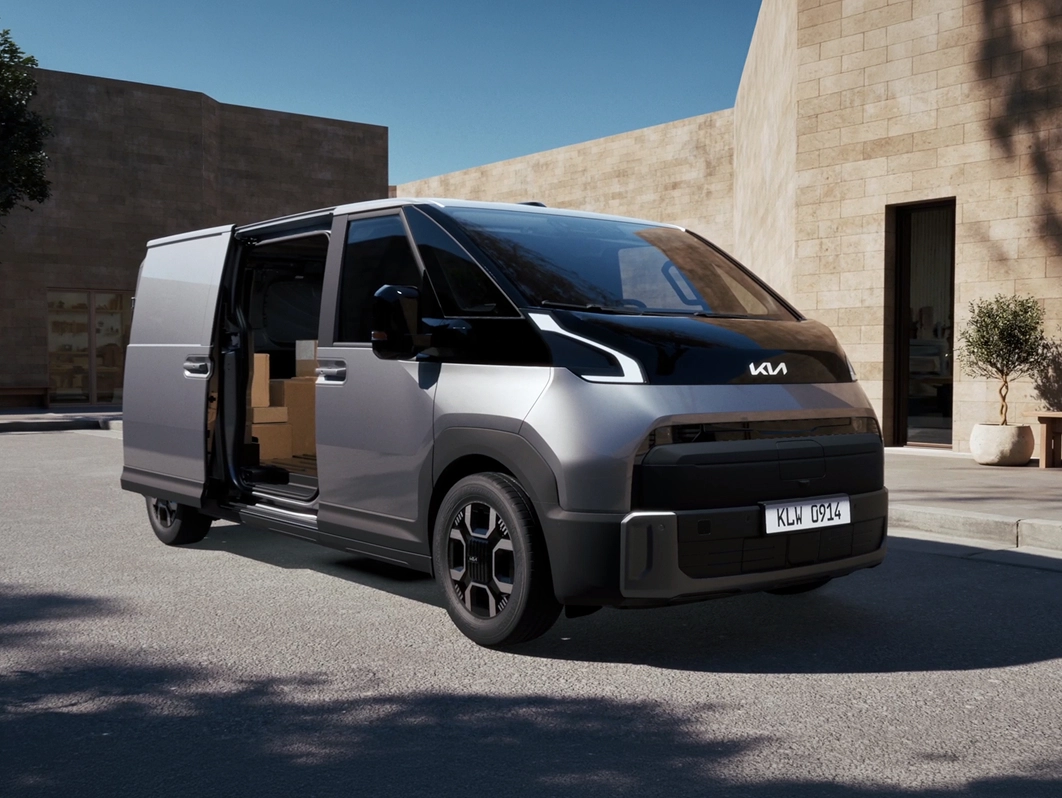
Kia is stepping up its challenge to the established van market with the reveal of the new Kia PV7, a fully electric medium van promising more load space, longer-range capability and considerably more flexibility than the smaller PV5.
Unveiled at IAA Transportation 2026 in Hannover, the PV7 is the second model in Kia’s growing Platform Beyond Vehicle, or PBV, family. It follows the award-winning PV5 and moves Kia into one of the most competitive parts of the commercial vehicle market, where it will ultimately find itself up against familiar names such as the Ford E-Transit Custom, Volkswagen Transporter and other medium-sized electric vans.
Kia plans to launch the PV7 in Europe during the second half of 2027, with Cargo and Passenger versions forming the basis of what will eventually become a much broader family of vehicles.
A proper medium-sized electric van
While the PV5 gives Kia an entry into the compact van market, the PV7 has been designed for businesses needing significantly more capacity.
In long-wheelbase Cargo form, Kia says the PV7 can provide up to 6.1m³ of load space, increasing to as much as 8.0m³ with the High Roof version. Depending on configuration, maximum payload is expected to reach 1,200kg.
That puts the PV7 firmly into serious working-van territory rather than simply being a passenger EV adapted to carry cargo.
The dedicated electric E-GMP.S architecture allows Kia to make greater use of the available footprint, with a flat floor and a design focused around maximising usable interior space. A low loading height should also make loading and unloading easier for drivers making repeated deliveries throughout the day.
Kia describes the PV7 as being designed for businesses including logistics operators, fleets, shuttle services and SMEs, although the number of planned derivatives means its potential use cases could become considerably wider.
Up to 286 miles of electric range
Range remains one of the biggest considerations for businesses considering a move from diesel to electric vans, and Kia appears to have made this a priority with the PV7.
Two battery sizes are planned, with 71.5kWh and 96.2kWh battery packs available depending on the version.
The Long Range Cargo model is expected to offer more than 460km of WLTP range, equivalent to around 286 miles on a charge.
For a medium-sized electric van, that could make the PV7 particularly interesting to businesses whose vehicles cover longer regional routes rather than simply operating on short urban delivery cycles.
Kia has also given the PV7 an 800-volt electrical architecture, technology more commonly associated with some of the company's passenger EVs. Using a suitable 350kW DC rapid charger, Kia says the battery can be charged from 10 to 80% in around the mid-20-minute range.
That combination of longer range and rapid charging could potentially reduce one of the biggest operational barriers to running electric vans, particularly where vehicles need to remain in use throughout the working day.
Up to 200kW of power
Depending on specification, the PV7's electric powertrain can produce up to 200kW, equivalent to around 272hp, and 420Nm of torque.
Front-wheel drive models will form part of the range, while Kia is also planning all-wheel-drive capability as the PV7 family develops.
Performance is unlikely to be the deciding factor for most van operators, but the additional capability could prove useful for heavier applications, conversions and businesses operating in more challenging conditions.
More than just a panel van
Perhaps the most interesting element of Kia's PBV strategy is that the PV7 isn't being developed as one van with a handful of specifications.
Kia plans to create up to 23 PV7 variants, including Cargo, Passenger, Chassis Cab and specialist conversion models.
Passenger versions will be capable of carrying up to nine occupants in global markets, creating opportunities for shuttle operators, crew transport, tourism and passenger services alongside the conventional panel van.
It follows the same principle Kia has already introduced with the PV5, where a dedicated EV platform can underpin a range of vehicles developed around different commercial requirements rather than forcing businesses to work around a conventional van design.
Technology designed around running a business
Kia is also looking beyond the physical van itself.
An integrated Fleet Management System will allow operators to monitor information including vehicle location, battery status and driver behaviour across multiple vehicles.
The PV7 will also feature Pleos Connect, Kia's connected infotainment and software platform. Its open ecosystem is designed to allow new features and services to be added over time through software updates.
There's also Gleo AI, a voice assistant that can be used to control vehicle functions, navigation and other features using natural speech.
Vehicle-to-Load, or V2L, technology will allow energy stored in the battery to power external electrical equipment too. For tradespeople and mobile businesses, that means the van could potentially provide power for tools or other equipment without requiring a separate generator or power supply.
Kia is getting serious about vans
The arrival of the PV7 is another indication that Kia's move into commercial vehicles is far more than a side project.
Its first dedicated PBV, the PV5, has already made a strong impression, including winning the 2026 International Van of the Year award. Kia's strategy will see the PV7 arrive in 2027 before an even larger PV9 joins the range in 2029.
For the UK market in particular, the PV7 could ultimately be the most important of the three.
The medium van category is one of the most important areas of the commercial vehicle market, covering everything from tradespeople and local delivery companies to major national fleets. Kia UK has previously described the PV7 as having the biggest market potential within its forthcoming PBV range.
If Kia can combine competitive pricing with a potential 286-mile range, rapid charging, a 1.2-tonne payload and the flexibility promised by its PBV platform, the PV7 could become a serious alternative to the established names businesses have traditionally turned to.
When will the Kia PV7 be available in the UK?
The Kia PV7 is expected to arrive in Europe during the second half of 2027, although final UK specifications, pricing and the exact model line-up have yet to be confirmed.
Rivervale will be following the PV7 closely as Kia releases further information ahead of its UK introduction.
If you're considering moving your business or fleet to electric vans, speak to the Rivervale team about your requirements and the electric commercial vehicle options available today.
Explore Van Leasing Deals