
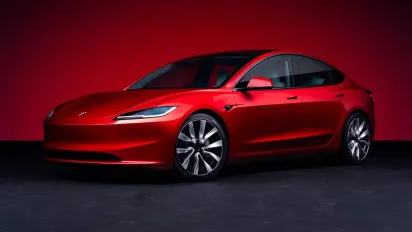
Tesla has changed the name of its Full Self-Driving technology in the UK and Europe, replacing the familiar Full Self-Driving (Supervised) branding with Tesla Assisted Driving.
The change is already visible on Tesla's UK website, where the manufacturer now describes Tesla Assisted Driving as technology that can drive the vehicle in a wide range of situations while under the driver's supervision.
It is an important change in terminology, but drivers shouldn't assume that Tesla has suddenly launched a completely different autonomous driving system.
The key difference, at least for now, is the name and a clearer description of the driver's responsibilities.
Why has Tesla changed the Full Self-Driving name?
The change follows concerns in Europe about whether the term "Full Self-Driving" accurately described a system that still requires a human driver to remain alert and responsible.
Germany's transport ministry had raised concerns that the existing name could be misleading because the system does not take over the entire task of driving. Tesla subsequently proposed the name Tesla Assisted Driving during discussions with the German government. The new name arguably gives drivers a much clearer indication of what the technology actually is: an advanced driver assistance system rather than a car that can simply be left to drive itself.
That's particularly relevant in the UK, where the terminology used to market increasingly sophisticated driving technology is about to become much more tightly controlled.
Is Tesla Assisted Driving different from Full Self-Driving?
The European name change itself does not mean that an existing Tesla has suddenly received fundamentally different self-driving capabilities.
The important point is that Tesla Assisted Driving still requires driver supervision.
Tesla's own UK website states that its currently enabled Autopilot and Tesla Assisted Driving Basic features require active driver supervision and do not make the vehicle autonomous. Drivers need to remain attentive and be prepared to take over.
So despite the considerable sophistication of Tesla's technology, "assisted" is the important word.
It helps distinguish between a system that can perform numerous driving tasks and a genuinely automated vehicle where a person is legally able to stop monitoring the driving task.
What is Tesla Assisted Driving Basic?
There is another change UK Tesla drivers may start noticing.
Tesla now refers to Tesla Assisted Driving Basic, or TAD Basic, as a package of advanced driver-assistance functions.
Tesla currently lists features including:
- Auto Lane Change
- Navigate on Autosteer (Beta)
- Autopark
- Dumb Summon
- Actually Smart Summon
- Traffic Light and Stop Sign Control (Beta)
Tesla also lists Autosteer on city streets as an upcoming feature. Exactly which features are available can vary according to the vehicle, hardware, software, country and regulatory approval.
Existing Tesla owners may notice the new terminology too. Tesla's UK support pages explicitly describe Full Self-Driving Capability as "now Tesla Assisted Driving Basic" in information relating to transfers between vehicles.
Can Tesla Assisted Driving drive itself in the UK?
This is where the distinction becomes particularly important.
Tesla's UK information says Tesla Assisted Driving itself is not yet available and that its availability depends on development and regulatory approval. Its UK used-car listings currently distinguish between Tesla Assisted Driving Basic and the future Tesla Assisted Driving system.
Tesla says eligible customers with TAD Basic will be moved to Tesla Assisted Driving at no additional cost when their vehicle becomes eligible following regulatory approval and receives the required software update.
That means drivers shouldn't interpret the new name as confirmation that Tesla's more advanced system has been approved for general UK use.
For British drivers, the important message remains straightforward: the currently available technology requires supervision and the driver remains responsible.
Why the wording matters in the UK
Tesla's decision is also well timed because Great Britain is introducing specific rules around the way automated driving technology can be marketed.
The Automated Vehicles (Marketing Restrictions) Regulations 2026 come into force on 7 January 2027 in England, Wales and Scotland. [legislation.gov.uk]
They restrict terms including:
- self-driving
- driverless
- autonomous
- autonomous driving
- automated driving
- drive itself
- drive autonomously
These terms will generally be reserved for vehicles that have been officially authorised or listed as automated vehicles.
The Department for Transport's reasoning is important. It says advanced driver assistance systems and self-driving vehicles need to be clearly distinguished because drivers must understand both the capability of the vehicle and their own legal responsibilities.
That makes Tesla Assisted Driving a much more literal description of the technology currently being offered to motorists.
Isn't Autopilot already driver assistance?
Yes, and this is where Tesla's terminology can understandably become confusing.
Autopilot remains Tesla's standard driver-assistance system. Tesla says it incorporates Traffic-Aware Cruise Control and Autosteer and comes as standard on every new Tesla.
Tesla Assisted Driving Basic sits above this with additional functionality such as automated lane-changing assistance, parking and Summon functionality. [tesla.com]
The distinction consumers need to remember is that increasingly sophisticated assistance does not automatically equal autonomy.
A car might be able to steer, accelerate, brake, change lanes or perform other manoeuvres, but that doesn't necessarily mean its driver can stop paying attention.
What does the change mean for existing Tesla owners?
For most existing UK Tesla drivers, the immediate impact of the announcement is likely to be terminology rather than a dramatic overnight change to the way their car drives.
Owners who previously encountered Full Self-Driving terminology may increasingly see Tesla Assisted Driving or Tesla Assisted Driving Basic instead.
Feature availability remains dependent on factors including the vehicle's specification and hardware, software version, location and regulatory approval.
Tesla's systems will continue to develop, however, and the more interesting story will be what happens when the company's more advanced Tesla Assisted Driving technology receives regulatory approval in additional European markets and potentially the UK.
What happens next?
Tesla has been pursuing wider European approval for its more advanced driver-assistance technology.
The Netherlands became the first European country to approve Full Self-Driving (Supervised) earlier in 2026. Rivervale previously covered that development when the approval was announced.
Germany's transport minister has subsequently indicated support for wider European approval following Tesla's change in terminology.
For UK drivers, though, regulatory approval remains the key thing to watch.
Tesla Assisted Driving may sound less ambitious than Full Self-Driving, but arguably it provides a better indication of where the technology currently sits.
These systems are becoming increasingly capable, but assistance and autonomy remain two very different things. Whatever technology is working in the background, drivers need to understand exactly what their vehicle can do, where it can do it and when they are still expected to remain in control.
Explore Current Tesla Deals


