
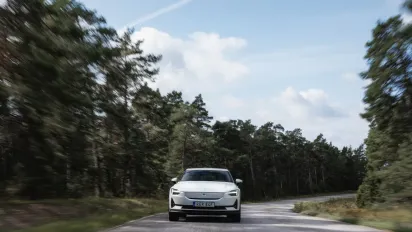
Quick verdict
I've used it around town, covered some lengthy motorway journeys and taken it onto the sort of flowing country roads where you can properly explore a car's chassis.
Across all three environments, the Polestar 2 impressed.
The Polestar 2 Long Range Dual Motor strikes a particularly appealing balance.
With 421hp, 740Nm of torque and all-wheel drive, there's more performance than most drivers will ever realistically need, but it doesn't feel like an EV built purely around acceleration figures.
Instead, it's composed, engaging and surprisingly rewarding to drive.
It is equally convincing over distance. The cabin is quiet, the seats are comfortable, the Google-based infotainment is simple to navigate and the Prime Pack adds an extensive collection of technology and comfort features.
Perhaps most impressive of all, the Polestar 2 still looks fresh several years after its introduction.

How powerful is the Polestar 2 Long Range Dual Motor?
The Long Range Dual Motor sits between the range-focused Long Range Single Motor and the flagship Dual Motor with Performance Pack.
There is an electric motor on each axle, giving the Polestar permanent access to all-wheel drive when required.
Together they produce 310kW, equivalent to 421hp or 416bhp, and 740Nm of torque.
That is enough to take the car from 0-62mph in approximately 4.5 seconds.
So although this isn't technically the Performance version, calling it slow would be rather difficult.
Polestar has also engineered the drivetrain so the front motor can disengage when it isn't required, helping to reduce energy consumption during more relaxed driving.
Official WLTP range is now as much as 370 miles, making the Dual Motor far more credible as a long-distance EV than earlier versions of the Polestar 2.

What is the Polestar 2 like to drive?
This was probably the biggest surprise during my time with the car.
The Long Range Dual Motor doesn't use the manually adjustable Öhlins dampers or upgraded Brembo braking system fitted to the Performance Pack.
Instead, it uses Polestar's standard dynamic chassis.
And yet on a good B-road, it is still enormous fun.
The steering has a reassuring weight to it and the car feels remarkably well controlled through a sequence of bends.
There's plenty of grip from the all-wheel-drive system and, with 740Nm available almost instantly, there's always substantial performance waiting when you accelerate away from a corner.
What makes the Polestar particularly satisfying is that it isn't simply about the power.
There are plenty of EVs capable of delivering rapid straight-line acceleration. The Polestar 2 feels like considerably more attention has been paid to what happens when the road starts twisting.
It changes direction neatly, remains composed and gives you confidence to enjoy the car.
For an electric fastback capable of travelling close to 370 miles according to the official test, that breadth of ability is impressive.

Motorway driving
Then you reach the motorway and the personality changes again.
This is an excellent long-distance car.
I've spent several hours at a time behind the wheel and the Polestar 2 simply gets on with covering miles.
The seats are particularly comfortable and supportive, wind noise is well controlled and road noise remains impressively subdued, even across rougher surfaces.
Having 421hp available also means overtaking is almost effortless.
You rarely need to plan particularly far ahead. Press the accelerator and there is immediately enough performance available to join faster-moving traffic.
Combined with the long official range and rapid charging capability, it's a very easy car to imagine using for substantial weekly mileage.

Pilot Assist
The Prime Pack includes Polestar's Pilot Pack and therefore adds Pilot Assist alongside a number of other driver-assistance technologies.
Pilot Assist combines adaptive cruise control with steering assistance to help the vehicle remain within its lane.
It generally makes motorway journeys easier, although I did find the steering assistance less determined to hold the Polestar perfectly in the centre of a lane than the equivalent system I've experienced in a Tesla.
On a couple of occasions the car moved slightly closer to a white line than I expected before making a correction.
It's important to remember that it remains an assistance system, rather than an autonomous driving function, and the driver remains responsible for controlling the vehicle.
Adaptive Cruise Control itself proved particularly useful on longer journeys.

Range and charging
The Long Range Dual Motor uses an 82kWh lithium-ion battery and offers an official WLTP range of up to 370 miles.
That's significant because choosing the extra performance and security of all-wheel drive no longer means sacrificing huge amounts of range.
The long-range battery can accept up to 205kW DC, with Polestar quoting approximately 28 minutes to charge from 10 to 80% in suitable conditions.
Connect to an 11kW three-phase AC charger and a full 0-100% charge takes around eight hours.
Google Maps also integrates directly with the car's charging system.
Navigate to a compatible rapid charger and the car can precondition its battery while you're driving, helping it arrive at an appropriate temperature for rapid charging.
For longer journeys, the navigation can also calculate expected battery level at your destination and help incorporate charging stops into the route.

Prime Pack: what do you get?
The Prime Pack effectively bundles together three of Polestar's major option packs: Pilot, Plus and Climate, as well as adding rear privacy glass.
That transforms an already well-equipped Polestar 2 into a particularly comprehensive specification.
The Pilot Pack introduces Pilot Assist, Blind Spot Information with steering assistance, Cross Traffic Alert with braking support, Emergency Stop Assist, a 360-degree camera and automatically dimming exterior mirrors.
The Plus Pack brings many of the features you're likely to notice every day, including the panoramic glass roof, Harman Kardon audio system, fully powered front seats, Digital Key, upgraded cabin air filtration and hands-free tailgate.
Then the Climate Pack adds the energy-saving heat pump, heated steering wheel, heated rear seats and heated windscreen washer nozzles.
It's a useful combination because the equipment isn't simply decorative. Most of it genuinely improves day-to-day ownership.
Harman Kardon sound system
This deserves its own section.
The Prime Pack's Harman Kardon Premium Sound system uses 13 speakers and a 600-watt amplifier, including an air-ventilated subwoofer.
It sounds excellent.
And that's true whether you're listening to something bass-heavy, singing along to a favourite track, playing a classical recording or simply listening to a podcast.
There's impressive clarity throughout the cabin and enough power to make music genuinely enjoyable without sacrificing detail.
On a long motorway journey, it's exactly the sort of option you quickly become grateful for.
Google built in
The Polestar 2 was one of the earliest cars to demonstrate how well Android Automotive could work when properly integrated into a vehicle.
The centrepiece is an 11.2-inch portrait touchscreen, while there's also a 12.3-inch digital driver's display directly ahead.
Google Maps, Google services and access to compatible apps are built directly into the car rather than simply mirrored from a phone.
The menus are straightforward and the system feels intuitive.
That's important because the centre screen controls a significant proportion of the vehicle's functions.
Polestar has managed to avoid making it feel unnecessarily complicated.
Some clever Polestar 2 touches
There are also several smaller features that become more useful once you start living with the car.
There's effectively no conventional start button.
Sit in the driver's seat, press the brake and select Drive.
When you reach your destination, select Park and leave the car.
Digital Key allows an authorised smartphone to unlock and start the vehicle.
The Plus Pack also includes a small Polestar logo projected onto the panoramic glass roof, while the powered tailgate can be opened hands-free.
There's a clever fold-up divider incorporated into the rear luggage floor too, complete with grocery bag hooks.
It's a simple idea, but one that stops your shopping rolling from one side of the boot to the other.
Interior quality
The cabin follows Polestar's typically understated Scandinavian design philosophy.
It's relatively minimalist, but doesn't feel stripped out.
There's a reassuring solidity to the controls and materials and everything feels very well assembled.
After a couple of weeks with the car, one of the things that stood out most was simply how substantial everything feels.
The seats deserve particular praise.
They're comfortable enough for several hours on the motorway while providing enough support when you're making use of the car's handling on a country road.
With the Plus element of the Prime Pack, the front seats are fully electrically adjustable, including lumbar adjustment and driver memory.
The panoramic roof also makes a significant difference to the ambience, allowing considerably more light into what is otherwise quite a restrained interior.

Practicality
Although it has the silhouette of a saloon, the Polestar 2 uses a large hatchback-style rear tailgate.
That makes the boot considerably easier to access than you might initially expect.
There's around 407 litres of rear luggage capacity, expanding to around 1,097 litres with the rear seats folded, plus another 41 litres of storage beneath the bonnet.
That front compartment is particularly useful for storing charging cables away from your luggage.
There's also underfloor storage and a ski hatch through the rear seats.
The Polestar 2 is capable of towing up to 1,500kg, further expanding its usefulness as an everyday family or company car.

Which Polestar 2 should you choose?
There are currently four principal powertrain configurations.
The Standard Range Single Motor produces 272hp and offers up to 344 miles of WLTP range.
The Long Range Single Motor increases power to 299hp while extending official range to as much as 409 miles.
Then comes the car tested here, the Long Range Dual Motor, with 421hp, all-wheel drive and up to 370 miles of range.
At the top sits the Long Range Dual Motor with Performance Pack, producing 469bhp and offering up to 352 miles of WLTP range.
For drivers prioritising maximum distance between charging stops, the Long Range Single Motor is likely to make most sense.
For those who want more performance and the reassurance of all-wheel drive without moving all the way into the more focused Performance model, this Long Range Dual Motor occupies a very appealing middle ground.
Final verdict
Perhaps the biggest compliment you can give the Polestar 2 is that it no longer feels like an alternative to the Tesla Model 3.
It has developed an identity of its own.
The combination of understated design, excellent build quality, straightforward Google technology and an engaging chassis makes it stand out in an electric-car market that is becoming increasingly crowded.
The Long Range Dual Motor might actually be the sweet spot.
There is more than enough performance to make it genuinely exciting, but you still get up to 370 miles of official range and a chassis that works brilliantly on a twisting road without stepping up to the dedicated Performance Pack.
Then you can join the motorway, turn up that excellent Harman Kardon sound system and cover several hundred miles in comfort.
Despite being one of the longest-serving models in Polestar's range, the Polestar 2 still has plenty to offer.
And after spending a couple of weeks driving one, it remains an EV that makes you want to find an excuse to take the longer route home.
View Polestar 2 Lease Deals


