
Quick verdict
The Leapmotor B10 is one of those cars that becomes more convincing the longer you spend with it. It does not have the badge recognition of a Kia, Skoda or Ford, and there are areas where its budget-conscious positioning shows, but the fundamentals are impressively strong.
It is spacious, comfortable, packed with equipment and remarkably easy to live with. Add a competitive 270-mile official range and the reassurance of Stellantis involvement, and the B10 starts to look like much more than another inexpensive Chinese EV.
The electric SUV that had to prove itself
There is no shortage of new electric cars arriving from China. In fact, keeping track of the badges appearing on UK roads is becoming something of a challenge in itself.
That means simply being inexpensive is no longer enough.
If a new manufacturer wants British drivers to take notice, the car needs to be good to drive, easy to live with and backed by enough infrastructure to give buyers and leasing customers some confidence that the brand will still be around when the car needs servicing.
That is where the Leapmotor B10 starts to become interesting.
Rather than judging it after a brief loop around a launch venue, I spent close to 600 miles with the B10, including taking it from Brighton to Manchester and back again. There were motorways, urban roads, country lanes, nighttime driving and several rapid-charging stops along the way.
By the end of it, the B10 had made a considerably stronger impression than I was expecting.
What exactly is Leapmotor?
For plenty of UK drivers, the name will still require an introduction.
Leapmotor is a Chinese manufacturer, but its expansion outside China is closely linked to Stellantis, the automotive group behind brands including Vauxhall, Peugeot, Citroën, Fiat and Jeep.
That relationship matters.
Stellantis owns a stake in Leapmotor, while the international business responsible for markets outside Greater China is operated through a joint venture between the two companies.
For customers, the important part is that Leapmotor has not simply landed in Britain and started from scratch. It has access to an established European automotive network and the experience of one of the world's largest car groups.
A famous parent company cannot turn a bad car into a good one, of course. Fortunately for Leapmotor, the B10 does plenty to justify its existence on its own.
How much does the Leapmotor B10 cost?
The B10 sits in an increasingly competitive part of the electric car market, rubbing shoulders with models including the Kia EV3, Skoda Elroq, Ford Explorer, Omoda E5 and BYD Atto 3.
It uses a 67.1kWh battery and a rear-mounted electric motor producing around 215bhp and 240Nm of torque, with an official WLTP range of up to 270 miles.
Those figures are perfectly respectable. It is the amount of car and equipment Leapmotor provides for the money that really grabs your attention.
The B10 has been positioned around the £30,000 mark for private retail buyers with Leapmotor's available manufacturer contribution, yet features that can quickly send you climbing through the trim levels of rival cars are already included.
You get electrically adjustable, heated and ventilated front seats, a heated steering wheel, a panoramic glass roof, large touchscreen, electric tailgate, parking technology and an extensive suite of driver assistance systems.
There is refreshingly little sense that you are being shown a reasonable headline price before discovering that all the equipment you actually want belongs to a much more expensive version.
That value proposition could also make the B10 particularly interesting as a lease car, where its combination of relatively modest list price and generous specification should appeal to drivers wanting plenty of equipment without stepping into a more expensive premium SUV.
Is it a good-looking car?
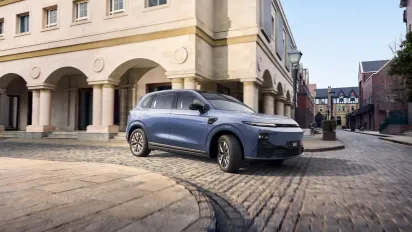
Perhaps the kindest description of the B10 is that it is handsome without desperately trying to attract attention.
Its slim front lighting, flush door handles and full-width rear light bar are all familiar ingredients in the modern electric SUV recipe. There is nothing particularly revolutionary here, but the proportions work well and I think it looks better out on the road than it does in some photographs.
Some emerging brands appear determined to prove their modernity by putting another crease, illuminated strip or decorative vent wherever they can find space.
Leapmotor has shown a little more restraint.
You probably will not park the B10 and find yourself turning around for another look, but neither does it feel like a design that is likely to age particularly quickly.
For a practical family SUV, that might be exactly the right approach.
What is the Leapmotor B10 interior like?
Step inside and the B10's price becomes a little more obvious.
There are some nicely padded surfaces and everything important felt solidly assembled in our test car, but there is no escaping the amount of harder plastic around the cabin. Anyone expecting £40,000 levels of perceived quality from a £30,000 EV may come away disappointed.
The dashboard is also slightly unusual. A series of slots and mounting points run across its upper section, creating an almost rugged, Defender-inspired appearance that feels slightly at odds with the otherwise minimalist and technology-focused interior.
It would not be my first choice of design, but it certainly gives the cabin some character.
More importantly, it is a pleasant place to spend time.
The enormous panoramic roof floods the interior with light, visibility is good and ambient lighting around the air vents adds some theatre after dark.
Leapmotor has even found a clever use for those lights.
When reversing towards an obstacle, the ambient lighting changes colour and begins to flash more urgently as the distance reduces. You still have the usual cameras, graphics and warning sounds, but having the cabin itself react to what is happening outside is surprisingly effective.
It is exactly the sort of small detail that helps the B10 feel like more than a collection of impressive numbers on a specification sheet.
Are the seats comfortable?
Mostly, although this was also one of my biggest criticisms after the Manchester journey.
The front seats look good, their side bolsters hold you nicely and having heating and ventilation as standard is excellent at this price.
What they lack is adjustment.
There is no adjustable lumbar support and I would have liked the ability to raise the front edge of the seat base to provide more support beneath my thighs.
During shorter journeys I had no complaints. After around 100 miles of motorway driving, however, I found myself shifting position more regularly and looking forward to the next opportunity to get out and stretch my legs.
Seat comfort is extremely personal, so this is not necessarily going to trouble every driver. If you regularly cover serious motorway mileage, however, I would spend more than five minutes sitting in one before making your decision.
For everyone else, the B10 is generally a comfortable car, and the ride quality helps enormously.
What is the Leapmotor B10 like to drive?
This is probably where the B10 surprised me most.
Some affordable electric SUVs feel as though ride and handling were fairly low down the development priority list. They can be overly firm, strangely floaty or simply lacking the polish you get from more established manufacturers.
The Leapmotor feels properly sorted.
Around town it is smooth and easy-going, absorbing rough surfaces without crashing through them. Out on the motorway it settles down nicely, feeling stable and composed even after several hours behind the wheel.
Leapmotor says European chassis tuning was carried out with input from Stellantis engineers, and whether you care about the engineering story behind it or not, the end result works.
There is nothing remotely hot-hatch-like about the B10. Steering is fairly light and there is not much feedback coming through the wheel, so anyone searching for an electric SUV to attack their favourite B-road should probably look elsewhere.
But that is missing the point.
For school runs, commuting, family journeys and motorway slogging, it is incredibly easy to drive.
The electric motor provides more than enough punch when joining a motorway or overtaking without delivering the neck-snapping acceleration some manufacturers seem determined to engineer into every EV.
Sometimes you just want to press the accelerator and move forward briskly rather than rearrange everything in the boot.
The B10 gets that balance right.
There are Comfort, Standard and Sport driving modes, along with adjustment for steering weight and regenerative braking. I spent most of my time in the regular settings because they suit the relaxed nature of the car particularly well.
There is some wind noise at motorway speeds, and more expensive rivals with acoustic glazing feel more isolated, but it never became intrusive enough to spoil a long journey.
Technology that you can actually understand
The B10's technology is another highlight.
A compact driver display sits directly ahead while a huge 14.6-inch touchscreen takes centre stage.
Large touchscreens are hardly unusual anymore. The important question is whether you can actually use them without wanting to throw something at the dashboard.
Fortunately, Leapmotor's system is quick.
Menus generally appear where you would expect them, reactions are fast and it did not take days of ownership before I could confidently find the major controls.
There are similarities to Tesla's approach, particularly in the way navigation can sit alongside a visualisation of surrounding traffic and other information can appear without completely replacing what you were already viewing.
The biggest compliment I can give the B10's navigation is that I actually used it.
Despite having Apple CarPlay available, the built-in navigation handled nearly all my driving during the test. Directions were clear, range information was useful and it even warned me when approaching a bus lane, including the times at which the restriction operated.
That is genuinely helpful rather than technology simply for the sake of having technology.
The car can also calculate remaining range dynamically using your recent driving behaviour. On the motorway this gives you a much more useful idea of how far you are actually going to travel than relying entirely on a theoretical figure.
Wireless Apple CarPlay was slightly less impressive and occasionally became sluggish while scrolling through music, although the car's own software remained responsive throughout.
A car with its own routines
Dig deeper into the menus and the B10 becomes even more interesting.
You can create automated routines in much the same way you might create smart-home commands.
For example, the car can perform a chosen action when you fasten your seatbelt, when the cabin reaches a particular temperature, when the vehicle reaches a certain speed or when the battery hits a chosen state of charge.
Do you need it? Probably not.
Will owners who love playing with technology lose an afternoon setting everything up exactly as they like it? Almost certainly.
There are also predefined modes for situations including camping, travelling with a pet and cleaning the car.
They are quirky touches, but they show Leapmotor has thought about how owners might interact with the B10 beyond simply getting from A to B.
The smartphone app was a different story
Unfortunately, not every piece of technology behaved itself during my test.
The Leapmotor app is designed to become an important part of the ownership experience, allowing you to check the battery, precondition the cabin, schedule charging, operate the locks and send destinations to the navigation system.
I could not get it working.
Despite successfully creating an account, the app repeatedly refused to log me in. Several password resets later, I eventually gave up.
That left me using the supplied NFC key card.
You tap it against the driver's door mirror to unlock the B10, then place it on the centre console before driving.
It works perfectly well in a technical sense.
In everyday life, however, it means taking the card out of your wallet whenever you return to the car, tapping the mirror and then putting it inside.
It quickly becomes a faff.
This could have been an isolated problem with my account or the press vehicle, rather than something every B10 owner will encounter. Even so, if the smartphone is intended to be such an important part of accessing and controlling the car, the experience needs to be completely reliable.
Is the Leapmotor B10 practical?
Very.
With a 2,735mm wheelbase and a completely flat rear floor, the B10 provides an impressive amount of passenger room.
Adults can sit comfortably in the back without feeling as though they have been relegated to the cheap seats, while the large glass roof makes an already spacious cabin feel even airier.
Rear passengers get their own ventilation outlets along with USB-A and USB-C connections, and there are ISOFIX mounting points on the outer rear seats.
Storage around the cabin is generous too.
Open the boot and you get 430 litres with the rear seats in use, expanding considerably once the 60:40 split-folding bench is lowered. The opening itself is wide and the shape is practical, which is sometimes more important in real life than claiming the largest possible figure on a specification table.
Having loaded it up for a weekend away, I had no complaints.
There is also a small compartment beneath the bonnet, ideal for storing charging cables without having to bury them beneath your luggage.
Vehicle-to-Load functionality adds another useful trick, allowing energy from the B10's battery to power compatible external electrical equipment. For camping trips, days out or simply keeping equipment running away from a conventional power supply, it gives the car another layer of versatility.
Can you really travel long distances in it?
Absolutely.
An official range of up to 270 miles means the B10 is unlikely to trouble the very longest-range EVs, but it offers enough for the vast majority of everyday journeys and did not make the Brighton-to-Manchester run feel remotely difficult.
I was not attempting an efficiency challenge. I drove at normal motorway speeds and treated the journey much as I would in any other electric car.
My usual approach on a long trip is to stop roughly every 100 miles or so rather than running the battery particularly low. By the time I have plugged in, found a coffee and used the facilities, the car has usually taken on more than enough energy for the next section.
That worked particularly well in the B10.
More importantly, its navigation and dynamic range calculations meant I was rarely second-guessing whether the number on the dashboard bore any relationship to how far I could actually travel.
For anyone still concerned that an affordable EV automatically means carefully planning every mile of a motorway journey, the B10 should provide some reassurance.
The headlights are ridiculously good
This sounds like an odd thing to single out, but the headlights genuinely deserve recognition.
Some modern LED systems appear incredibly bright when you are approaching them from the opposite direction yet somehow fail to give the driver a particularly good view of the road ahead.
The B10's lights were excellent.
On dark roads they produced a long, clear view without leaving me peering beyond a concentrated patch of bright light immediately in front of the car.
I could almost see next week's lottery numbers.
Sadly, not quite.
Safety technology: brilliant on the motorway, less so in the countryside
There is no shortage of driver assistance technology either.
The B10 includes systems such as adaptive cruise control, lane centring, lane-keeping assistance, blind-spot monitoring and rear cross-traffic braking, while the car has achieved a five-star Euro NCAP safety rating.
On the motorway, it works well.
Adaptive cruise control and lane centring took some of the effort out of the longest sections of my journey without constantly reminding me they were there.
Move onto a narrow country lane and things become slightly less harmonious.
Where clear white lines disappeared, the lane assistance occasionally seemed unsure where the edge of the road was, pulling the steering in a way that felt more distracting than helpful.
It can be switched off, but I would like the main control to be easier to reach.
The B10 does have a customisable shortcut menu, although I could not add the primary lane-assistance setting to it. Being able to place it prominently on the screen would make a noticeable improvement on typical British B-roads.
There are some nice safety ideas elsewhere. When a door is opened, for example, the indicator on that side flashes to help alert approaching traffic or cyclists.
It is a small touch, but another sign that Leapmotor is thinking beyond the obvious equipment list.
Is the Leapmotor B10 worth considering?
After nearly 600 miles, the B10's appeal becomes remarkably simple.
Leapmotor has not built a bargain electric SUV that you forgive because it is cheap.
It has built a genuinely capable electric SUV that also happens to be very competitively priced.
There are imperfections. Cabin plastics remind you where money has been saved, the front seats could provide more support on a long journey and some of the driver assistance systems need a little more polish. My problems with the smartphone app also highlighted how frustrating a digitally focused car can become when one part of that ecosystem refuses to cooperate.
But none of those things fundamentally undermine what the B10 does well.
It rides nicely, has plenty of space, provides useful real-world range, is loaded with equipment and has technology that mostly makes life easier rather than adding complexity.
And then there is the Stellantis connection.
For a new Chinese car manufacturer trying to convince British customers to take a chance on an unfamiliar badge, having one of the world's largest automotive groups involved in the business adds a level of confidence that some newcomers simply cannot offer.
The B10 is not a premium SUV in disguise and it is not going to transform an ordinary journey into a driving experience.
It does something arguably more useful.
It makes a spacious, well-equipped family EV feel attainable.
In an electric SUV market where prices can climb very quickly once you start ticking option boxes, that makes the Leapmotor B10 very difficult to ignore.
Rivervale verdict
The Leapmotor B10 might not be the electric SUV you have been dreaming about, but it could be one of the easiest to recommend.
Its combination of comfort, space, generous equipment and usable range makes it a convincing family car, while competitive pricing gives it a genuine advantage over many established rivals.
A few rough edges remain, particularly around seat comfort, some driver assistance systems and our experience with the smartphone app, but after nearly 600 miles the overriding impression was positive.
If you are considering the Kia EV3, Skoda Elroq, Ford Explorer, BYD Atto 3 or another compact electric SUV, the Leapmotor B10 deserves to be on the test-drive list.
And if the badge is the only thing making you hesitate, the involvement of Stellantis might provide exactly the reassurance you need.


