
Quick verdict
The Cupra Tavascan proves that sharing technology with other Volkswagen Group electric cars does not have to mean sharing their personality. It is striking to look at, interesting inside and genuinely enjoyable to drive, particularly in 340PS VZ form.
There are compromises. The touchscreen still takes on too many jobs, the coupe-style roofline affects rear visibility and the largest wheels do little for the ride. However, if you want the practicality of a family EV without something that simply disappears into the car park, the Tavascan makes a very convincing case for itself.

The Tavascan shows what Cupra does differently
There is no shortage of electric SUVs. In fact, choosing one is becoming increasingly difficult simply because there are so many capable options competing for attention.
The Cupra Tavascan therefore arrives with a challenge. Underneath, there is plenty that will be familiar to anyone who knows the Volkswagen Group's electric cars. It uses the MEB architecture that has also underpinned models including the Volkswagen ID.4 and Skoda Enyaq.
Cupra could quite easily have produced another variation on the same theme. Instead, it has created something that feels noticeably different.
That starts before you have even opened the door.
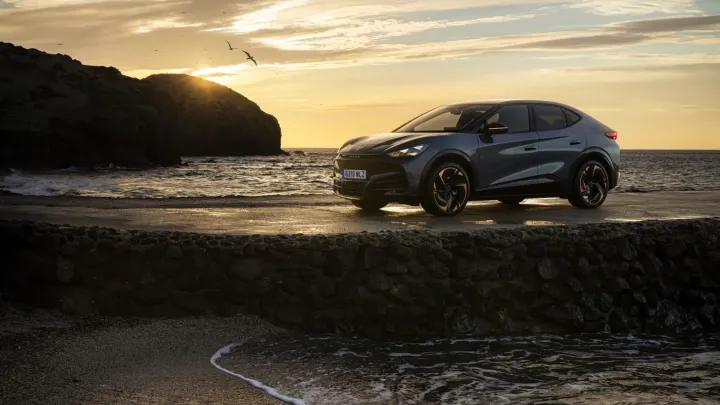
The Tavascan has presence in a way that relatively few family-focused electric SUVs manage. Its low nose, heavily sculpted bodywork, coupe-style roofline and distinctive lighting give it a much more dramatic appearance than its sensible dimensions might suggest.
It is a car that looks like Cupra wanted to design something interesting first and worry about fitting it into the electric SUV template afterwards.
And I rather like that.

Pros
- Distinctive exterior styling
- Interesting, high-quality interior
- Spacious cabin and 540-litre boot
- Strong performance from the VZ
- More engaging to drive than many electric SUVs
Cons
- Too many functions controlled through the touchscreen
- Ride can become firm on 21-inch wheels
- Rear visibility is limited
- VZ versions become considerably more expensive
Design that doesn't disappear into the background
The front is dominated by Cupra's triangular lighting signature, along with an illuminated badge sitting above the nose. Move around the side and the roofline drops away towards the rear, while large wheel designs and muscular bodywork help give the Tavascan a much wider, lower appearance than a conventional SUV.
Our VZ test car looked particularly good sitting on its 21-inch alloys. They fill the arches beautifully and suit the exaggerated design, although there is a price to pay once the road surface deteriorates.
The rear is arguably even more distinctive, with its illuminated Cupra logo and full-width lighting helping the Tavascan create an identity of its own after dark.
Whether everybody will like it is another question. Cupra rarely seems interested in designing cars that offend nobody, and that is perhaps part of the appeal.
Among increasingly similar-looking electric crossovers, I would rather have something that divides opinion than something completely forgettable.

The interior might be even more interesting
Open the door and Cupra has resisted the temptation to simply place a big screen on an otherwise empty dashboard.
The centrepiece is what Cupra calls the 'spine', a dramatic Y-shaped structure that sweeps down from the dashboard towards the centre console. It sounds like the sort of design feature that could easily become a gimmick, but it works surprisingly well.
It gives the cabin some architecture.
Copper detailing, sculpted surfaces and supportive bucket seats continue the theme, while the driving position feels suitably sporty for something that still needs to perform everyday family duties.
There is also a noticeable effort to make the Tavascan feel different from the Volkswagen and Skoda products with which it shares some of its engineering.
That matters because the Tavascan isn't simply competing on battery size or boot capacity. Part of its appeal is the way it makes you feel when you climb inside.

Technology is impressive, but not always easier
Sitting prominently in the centre of the dashboard is a 15-inch infotainment display.
It is large, crisp and responsive, and the latest software is noticeably better organised than some of the earlier Volkswagen Group systems. Navigation, media and vehicle settings are presented clearly and the system generally feels quick enough to keep up with you.
The problem is that the Tavascan still asks the screen to do rather too much.
Temperature and volume controls rely heavily on touch-sensitive interfaces. They are illuminated, which is an improvement on earlier systems, but neither is as intuitive as reaching for a physical switch or rotary controller while driving.
It isn't a deal-breaker, and you soon become familiar with where everything lives, but it remains one of those examples where adding more technology has not necessarily made something easier to use.
Higher-specification models compensate with some genuinely impressive kit. The available augmented-reality head-up display is particularly effective, placing navigation instructions within your line of sight, while the Sennheiser premium audio system gives the cabin a suitably upmarket soundtrack.
Cupra's current specification also includes a larger 10.25-inch Digital Cockpit and, on selected versions, features including Matrix LED headlights, panoramic glass and more advanced parking technology.
What's the Cupra Tavascan like to drive?
This is where the Tavascan starts to justify the Cupra badge.
The VZ uses two electric motors to produce 340PS and all-wheel drive, taking it from 0-62mph in 5.5 seconds.
In modern EV terms that figure might not sound outrageous, but it is difficult to imagine anyone climbing out and complaining that it needs to be quicker.
Put your foot down and acceleration is immediate and strong, without feeling needlessly aggressive. Rather than chasing the almost comical straight-line acceleration figures offered by some electric cars, the Tavascan feels quick enough to be entertaining while remaining easy to drive smoothly.
More importantly, Cupra has done something with the chassis.
At more than two tonnes, you are never completely unaware of the Tavascan's weight, but it changes direction confidently and controls its body movements well. Steering is quick and nicely weighted, making the car feel smaller from behind the wheel than its dimensions suggest.
Cars equipped with Dynamic Chassis Control give you further opportunity to alter the character. At its sportiest, the Tavascan remains remarkably composed when pushed through a series of corners.
It isn't a lightweight hot hatch hiding underneath an SUV body, but compared with many electric family SUVs it feels noticeably more interested in involving its driver.

The downside of those big wheels
There is inevitably a compromise.
Our VZ's 21-inch wheels looked fantastic, but on rougher British roads they made themselves known. Sharper imperfections can find their way into the cabin and, in the firmer chassis settings, things can become a little busy.
It never becomes unbearable, but anyone prioritising comfort over ultimate appearance or performance should think carefully before automatically choosing the biggest wheels.
For many drivers, one of the rear-wheel-drive versions could actually prove to be the more rounded Tavascan.
You lose the VZ's headline acceleration and all-wheel-drive traction, but gain a car that is still powerful, potentially more efficient and likely to make more sense for the school run, commute and motorway journeys that will occupy most of its life.

Range and charging
The Tavascan range has expanded since its original UK introduction.
For 2026 there are 58kWh and 77kWh battery options, depending on specification. The smaller-battery version prioritises affordability, while the 77kWh rear-wheel-drive model combines 286PS with the longest potential range. VZ models use the same 77kWh usable battery but add a second motor and all-wheel drive.
Official range varies according to version and specification, with current 2026 models offering more than 300 miles from the larger battery in the right configuration. CUPRA quotes up to 340PS from the range and charging at up to 135kW, with a 10-80% rapid charge taking around 29 minutes under suitable conditions.
During our time with the VZ, we averaged around 3.5 miles per kWh. Applied to the 77kWh usable battery, that would suggest somewhere around 260-270 miles of achievable driving range, depending on temperature, speed and driving conditions.
That feels perfectly usable for an electric family car. Home charging should cover the vast majority of everyday use, while the rapid charging performance makes longer motorway journeys realistic rather than something requiring military-level planning.
The Tavascan isn't the fastest-charging electric car available, with models based on 800-volt platforms able to accept substantially higher peak speeds, but 135kW should still be enough for most owners.
Is it practical?
The styling suggests practicality might have been sacrificed for appearance, but thankfully that isn't really the case.
At 4,644mm long, the Tavascan sits comfortably within family SUV territory. There's generous space up front and excellent rear legroom, helped by the EV platform and its flat floor.
That means the middle rear passenger doesn't have to spend the journey fighting a large transmission tunnel, while adults can comfortably occupy the outer rear seats.
The descending roofline does reduce the sense of space slightly towards the back, particularly for taller passengers, but it isn't the dramatic compromise you might expect from looking at the exterior.
Then there is the boot.
At 540 litres, it should comfortably deal with luggage, shopping, pushchairs and the assorted belongings that family cars inevitably accumulate.
There is no front boot, which feels like something of a missed opportunity, although space beneath the rear load floor gives you somewhere to keep charging cables out of the way.
Rear visibility is the bigger compromise. That dramatic rear styling and sloping glass make the view through the rear-view mirror relatively restricted, so parking cameras and sensors quickly become useful rather than merely nice to have.

Which Cupra Tavascan should you choose?
The answer largely depends on why the Tavascan interests you.
If it is the design, cabin and general character that have drawn you towards the car, you don't necessarily need the VZ.
The current range starts with the Origin from £39,995, followed by V1 and V2 versions. The V2 adds equipment including 20-inch wheels, electrically adjustable seats, a top-view camera and the Sennheiser sound system.
That makes the middle of the range particularly interesting.
The VZ1 and VZ2 sit considerably higher at £54,930 and £59,830 respectively at the time of writing, adding the 340PS all-wheel-drive powertrain alongside more performance and luxury equipment.
If you enjoy driving and want the version that delivers the fullest Cupra experience, the VZ makes sense.
But for someone looking primarily for a stylish electric family car, one of the rear-wheel-drive models arguably represents the smarter choice.

What does the Tavascan compete with?
The Tavascan finds itself in one of the busiest parts of the electric car market.
The Skoda Enyaq Coupé offers similar underlying technology with a more restrained personality, while the Volkswagen ID.5 takes another interpretation of the coupe-SUV formula.
The Ford Capri is another obvious alternative, combining familiar Volkswagen Group EV technology with its own distinctive positioning, while cars such as the Tesla Model Y focus heavily on efficiency, charging infrastructure and practicality.
Then there is the Kia EV6, which offers similarly bold styling and benefits from much faster 800-volt rapid charging.
None makes the Tavascan an easy choice.
But equally, none renders it irrelevant. Cupra has given the Tavascan enough of its own identity that choosing one feels like more than simply selecting a different badge attached to familiar technology.
Running a Tavascan in 2026
Electric cars are no longer exempt from Vehicle Excise Duty. For the 2026/27 tax year, a new zero-emission car pays £10 in its first year and £200 at the standard rate thereafter. Electric cars with a list price above £50,000 may also attract the Expensive Car Supplement from years two to six.
That threshold is worth remembering when comparing standard Tavascan models with the considerably more expensive VZ versions.
For company car drivers, however, electric cars remain particularly attractive. A zero-emission company car attracts a 4% Benefit-in-Kind rate during the 2026/27 tax year, still significantly lower than most comparable petrol, diesel or hybrid cars.
That could make the Tavascan especially interesting as a company car or through an eligible salary sacrifice scheme.
Cupra Tavascan verdict
The clever thing about the Cupra Tavascan isn't that Cupra has somehow reinvented the electric SUV.
It hasn't.
What it has done is take a fundamentally sensible electric-car platform and inject some personality into it.
The styling is brave, the interior is interesting and, crucially, the way it drives feels appropriate for something wearing a Cupra badge. The VZ in particular is fast, composed and entertaining enough to remind you that choosing a family EV doesn't automatically mean giving up on enjoying the journey.
There are things we would change. Physical controls would improve the cabin considerably, the largest wheels compromise the ride and the VZ becomes expensive once you move towards the top of the range.
But those imperfections almost underline what is good about it.
The Tavascan doesn't feel as though it was designed entirely by spreadsheet.
For drivers who want maximum practicality or the fastest possible charging, there are arguably stronger alternatives. But if you want an electric SUV that offers space, usable range and everyday practicality while still having enough character to make you look back after you've parked it, the Cupra Tavascan deserves a place near the top of your shortlist.
And perhaps the best compliment we can give it is this: after driving countless competent electric SUVs, the Tavascan is one of the ones you're actually likely to remember.


