
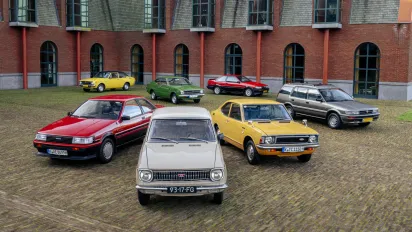
Few cars can claim to have stayed relevant for six decades. The Toyota Corolla can.
First launched in Japan in 1966, the Corolla has now reached its 60th anniversary, spanning 12 generations and more than 57 million sales worldwide. According to Toyota, more cars have carried the Corolla name than any other, earning it recognition as the world's best-selling car.
But longevity alone isn't what makes the Corolla interesting.
Over those 60 years it has been a family saloon, estate, hatchback, coupé and even a motorsport contender. It has gone from simple petrol engines and four-speed manual gearboxes to today's hybrid powertrains, digital displays, connected technology and advanced driver assistance systems.
So, how did the Corolla get here?
1966: Toyota's 'people's car'
The original Corolla arrived at a time of rapid change in Japan, when car ownership was becoming increasingly desirable as cities expanded and new suburbs developed.
Toyota's answer was a car designed to be affordable without simply being basic transport.
The first Corolla was launched in Japan in November 1966 following its appearance at the Tokyo Motor Show. Initially offered as a two-door saloon with a 1.1-litre, 60bhp engine, it already included features such as a floor-mounted four-speed gearbox, disc brakes, bucket seats and multi-point seatbelts.
Within just three years, the Corolla had become Japan's best-selling car.
That established a formula Toyota has arguably been refining ever since: build a practical, accessible car, but continue adding the technology, comfort and features customers expect as the market changes.
Twelve generations of gradual reinvention
Rather than completely reinventing the Corolla every few years, Toyota developed it generation by generation.
The second-generation car arrived in 1970 as Corolla passed one million sales. By its third generation, Toyota was using wind-tunnel testing, introducing greater passive safety and developing new solutions to meet increasingly stringent emissions requirements.
The fourth generation introduced a diesel engine, while the fifth brought front-wheel drive to the Corolla and made greater use of computer technology in vehicle and powertrain development.
Later generations increasingly reflected European tastes. The eighth-generation Corolla marked the beginning of versions developed specifically for the European market, while the ninth generation included hatchbacks built here in Britain.
Perhaps the most important change for the Corolla we know today, however, arrived under a different badge.
The Corolla that wasn't called a Corolla
If you drove a Toyota Auris in Britain, you were effectively part of the Corolla story.
For its 10th and 11th generations, the hatchback was sold as the Toyota Auris in Europe while the Corolla name continued elsewhere.
And there was an important development during that period.
In 2010, Toyota introduced the Auris Hybrid. Built by Toyota Motor Manufacturing UK, it became Toyota's first hybrid vehicle to be mass-produced in Europe and helped establish hybrid power within Toyota's mainstream European range.
In 2019, the Corolla name returned to the UK with the arrival of the 12th generation.
Today, the Corolla sits within a much wider range of Toyota lease deals, with electrified powertrains playing an increasingly important role across the manufacturer's line-up.
From sensible family car to cult hero
There's another side to the Corolla story that its sensible reputation doesn't always reveal.
The AE86 Corolla, produced as part of the fifth-generation range between 1983 and 1987, developed a very different following.
With a front-engine, rear-wheel-drive layout, a weight of less than one tonne and a high-revving 1.6-litre engine, the AE86 earned a reputation as a rewarding driver's car. It competed in rallying and circuit racing, found a natural home in drifting and achieved wider recognition through the Japanese Initial D series.
Its influence can still be seen in Toyota today. The Japanese nickname 'Hachi-Roku', meaning 86, was subsequently revived for the Toyota GT86 and GR86 sports cars.
Corolla has a serious motorsport history too
The Corolla's competition history goes far beyond the AE86.
A second-generation Corolla gave Toyota its first World Rally Championship victory, while the later Corolla AE111 went on to win three events during 1998 before helping Toyota secure the 1999 World Rally Championship manufacturers' title.
The Corolla AE86 also recorded back-to-back British Touring Car Championship series victories in 1986 and 1987, and Corolla has competed in the BTCC again since 2019.
Toyota has even used a hydrogen-fuelled GR Corolla H2 Concept in Japanese endurance racing as part of the development of hydrogen combustion engine technology.
The Toyota Corolla is also a British-built car
For UK drivers, there's another significant part of the Corolla story.
Toyota Motor Manufacturing UK's Burnaston plant in Derbyshire began producing the Corolla in 1998. Auris production followed in 2007, before the Corolla name returned with the current generation. Today, the UK plant is Toyota's European production centre for the Corolla Hatchback and Touring Sports.
Corolla has also become an important European success story. Almost 9.5 million Corollas have been sold in Europe, representing around one in six of all Corollas sold worldwide.
What is the Toyota Corolla like today?
Today's Corolla is a very different proposition to the 1.1-litre car that started the story in 1966, although its emphasis on practical, mainstream motoring remains recognisable.
The current European Corolla was launched in 2019 and is based on Toyota's TNGA C-platform. In Europe, it has been hybrid-only since launch.
For the latest Hatchback and Touring Sports, Toyota offers two hybrid systems: a 1.8-litre producing 138bhp and a more powerful 2.0-litre producing 176bhp.
There's considerably more technology inside too. The latest range includes a customisable 12.3-inch digital driver's display and Toyota Smart Connect+ through a 10.5-inch touchscreen, including cloud-based navigation and traffic information.
Toyota Safety Sense is also standard, including technologies such as Intelligent Adaptive Cruise Control, Lane Departure Alert, Lane Trace Assist, Emergency Steering Assist and Road Sign Assist.
In other words, the basic Corolla idea hasn't disappeared. The technology around it has simply changed enormously.
For drivers considering one today, you can explore Rivervale's latest Toyota Corolla lease deals, including current personal and business leasing options.
A special Corolla for its 60th birthday
Toyota is marking the anniversary with a limited-edition Corolla Hatchback.
The 60th Anniversary model comes exclusively with the 1.8-litre hybrid system and features Boreal Blue metallic paint contrasted with an Eclipse Black roof and pillars. It also receives distinctive 17-inch alloy wheels, exterior detailing and 60th Anniversary touches inside and out.
Toyota says it will be offered in strictly limited numbers.
What comes after 60 years of Corolla?
Perhaps the most interesting part of the anniversary is that Toyota is already considering what a future Corolla could become.
At the 2025 Japan Mobility Show, Toyota revealed the Corolla Concept, exploring a radically different design while being developed to accommodate multiple potential powertrain options.
That might ultimately be the secret behind the Corolla's longevity.
The car launched in 1966 and the Corolla available today have relatively little in common mechanically. Yet the idea behind them is remarkably similar: make a car that works for a huge number of people, then keep adapting it as their expectations change.
Twelve generations and more than 57 million sales suggest that approach has worked.
Thinking about a Toyota Corolla?
From the original 1966 model to today's hybrid Hatchback and Touring Sports, the Corolla has spent 60 years evolving with the people who drive it.
Explore the latest Toyota Corolla leasing deals from Rivervale below, with options available for both personal and business customers.
Current Toyota Corolla Car Leasing Deals


